

By Mubarak Mugabo
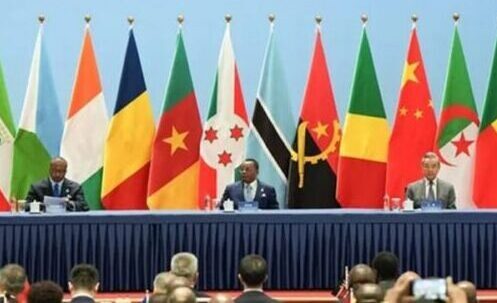
This year is exactly 25 years since the establishment of the Forum on China-Africa Cooperation (FOCAC). Founded on 10th October 2000, FOCAC is the official high-level political coordination forum between the People’s Republic of China and all African nations except one.
The forum also serves as the primary multilateral consultation and cooperation mechanism between China and Africa, founded on the premise of strengthening diplomacy, security, investment, and trade.
The forum has been a vehicle for building bridges and breaking walls between China and Africa, making China Africa’s largest trading partner for the last 16 years. According to China’s Ministry of Commerce, China-Africa bilateral trade volume reached a record high of $285 billion in 2024, surpassing that of the European Union and Africa.
These milestones have been enabled by the mutually beneficial win-win cooperation established by FOCAC with the blessing of the African Union.
Africa for years has had what Uganda’s President Yoweri Museveni coined as strategic bottlenecks hindering Africa from social-economic transformation. These bottlenecks, among others, include an underdeveloped infrastructure, human resources, and agricultural sector.
Caused by a bigger infrastructure funding deficit, which traditional aid from western partners had either knowingly or unknowingly ignored to focus on promoting western democratic values. The African Development Bank in 2000 estimated that $130-170 billion per year was required to fund infrastructure development in Africa.
For example, Uganda’s total installed electricity generation capacity was below 400 megawatts, according to the Uganda Regulatory Authority (ERA). By the way, ERA was also established in 2000, congratulations on making 25 years of lighting Uganda.
As of January 2025, Uganda’s installed generation capacity had grown to 2052 megawatts due to proper planning by Uganda’s Ministry of Energy and Mineral Development enabled by funding from China.
The Ugandan government must also be hailed for being visionary and strategic, aligning its budgetary priorities with those espoused under FOCAC. They realized that FOCAC is where the improvement of infrastructure as a path for industrialization, wealth creation, and development is prioritized.
The electricity deficit experienced by Uganda in early 2000’s saw the country’s load shedding become the new normal. China under FOCAC funded the Karuma hydroelectric dam adding 600 megawatts to the national grid on top of 183 megawatts from the Isimba hydroelectric power plant.
There are other visible physical infrastructures developed under FOCAC, including the expansion of Entebbe International Airport, the construction of the Kampala-Entebbe Expressway, which reduced the travel time from two hours to about 30 minutes, and the many factories located in the industrial parks of Mbale, Nakaseke, and Mukono.
FOCAC has also responded to calls for human resource development in Africa by offering full scholarships to African students and professionals in the various Chinese universities.
At the first FOCAC summit in 2006, then-President Hu Jintao announced that China was to increase Chinese government scholarships to African students from 2000 to 4000 by the year 2009.
The second summit, and the first to be held in Africa, saw Chinese president Xi Jinping offering at least 30,000 government scholarships to African students. This 2015 Johannesburg summit also saw President Xi pledging $60 billion for African development until 2018.
China increased scholarships from thirty thousand to fifty thousand from 2018 to 2021. During the 2024 summit in Beijing, President Xi even pledged sixty thousand scholarships for African students. Most scholarships are in science and technology study fields where students are awarded with certificates, diplomas, degrees, and PhDs.
According to the Chinese embassy in Uganda, the Chinese government offers at least 100 government scholarships to Ugandan students every year.
The effort to develop Africa’s human resources is one way FOCAC has helped Africa deal with a bulging unemployment rate in Africa and another effort geared at preparing an innovative young population.
All this has been attained without political or any other strings attached. FOCAC is luckily guided by the principles of mutual respect, mutual benefit, win-win cooperation, and non-interference.
Unlike the World Bank and major countries in the West, which have on several occasions suspended funding to Uganda over issues related to Uganda’s internal affairs, China, on the other hand, is increasing support.
FOCAC, through its political guidance mechanisms, has enabled deeper exchanges between China and Africa, especially in areas of people-to-people, trade, and investment.
Despite being maliciously undermined and attacked by Western actors, China’s cooperation with Africa is by far mutually consultative and beneficial.
Improving Africa’s infrastructure and human resources has set Africa ready to fairly participate in global trade and governance. It is only right and fair to congratulate Africa, China, and our people for these 25 years of transformative consultation, coordination, and cooperation.
Mubarak Mugabo is an Founding Fellow at the African Institute for Belt and Road

